Saltmere: Keeping One AI Character Across Three Episodes (Case Study)
How we made a three-episode AI series with the same character in every shot, with measured face similarity, what still drifts, and the real cost: US$6.41 for the whole demo.
Yes, AI can keep the same character across a series, if every shot starts from shared references and the face is measured. In Saltmere, three 18-second episodes made with Series Lock, the lead character's front close-ups scored 0.64 to 0.74 face similarity against her anchor, while a lookalike made from the same text alone scored 0.50 to 0.55. The whole demo, tests included, cost US$6.41. Faces that turn away or are lit from the side still drift during motion, and this post shows where.
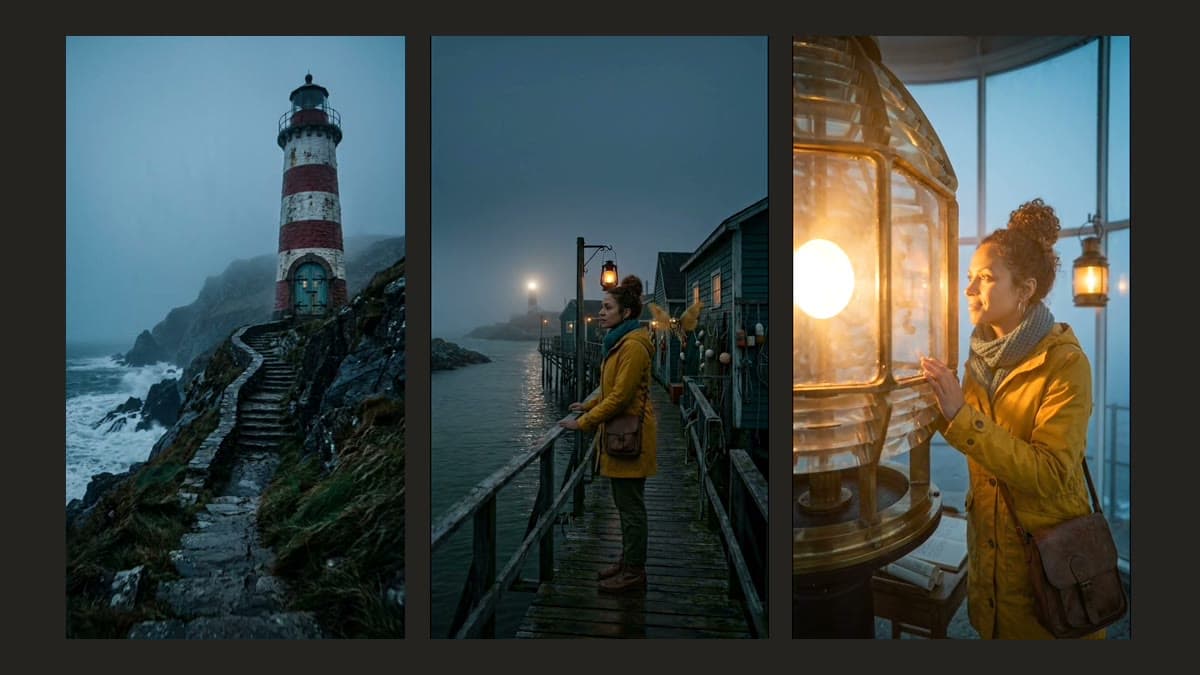
What is Saltmere?
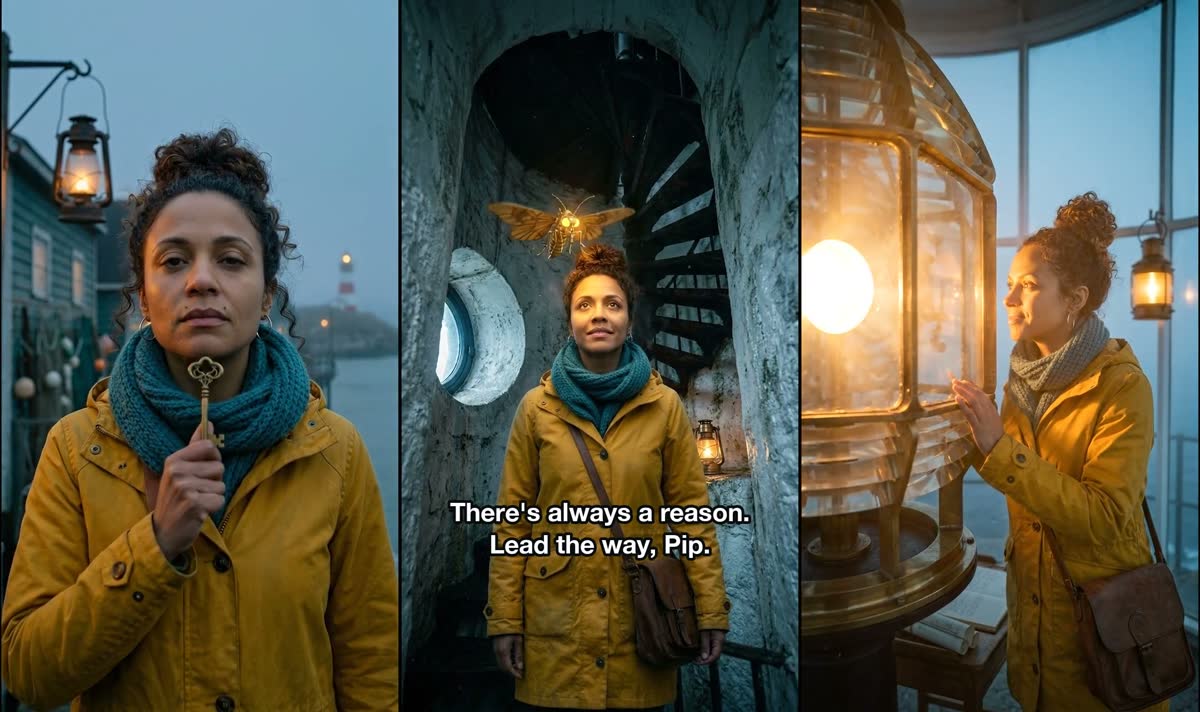
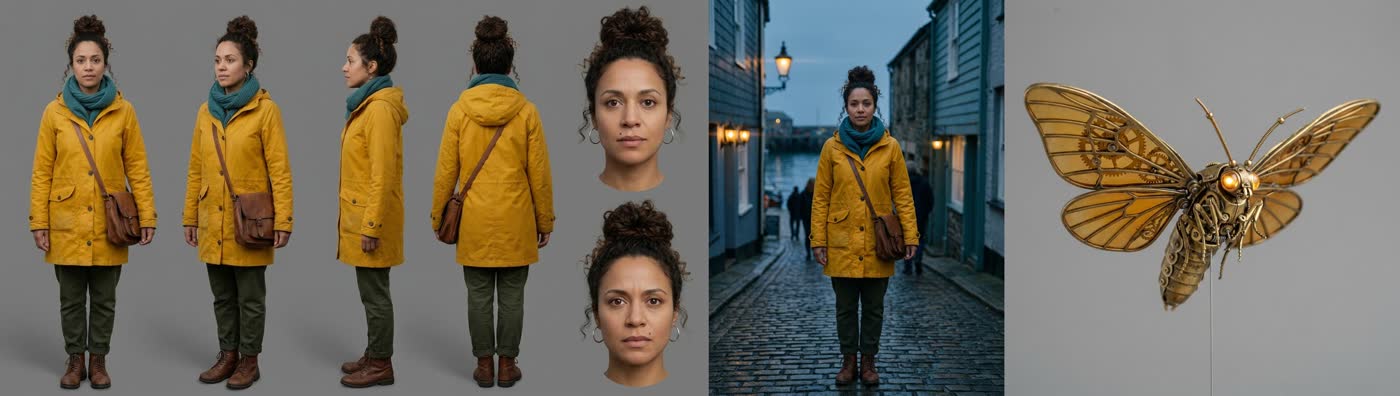
Saltmere is a short mystery series in 9:16. Nora Vey, a young cartographer in a mustard raincoat and a teal scarf, with curly hair in a high bun and a small mole above her lip, travels with Pip, a palm-sized brass clockwork moth. In a fog-bound fishing town, the lighthouse goes dark.
| Episode | Title | Length |
|---|---|---|
| 1 | The Light Went Out | 18 s, 3 shots of 6 s |
| 2 | The Keeper's Door | 18 s, 3 shots of 6 s |
| 3 | The Lamp Room | 18 s, 3 shots of 6 s |
What went into the series bible?
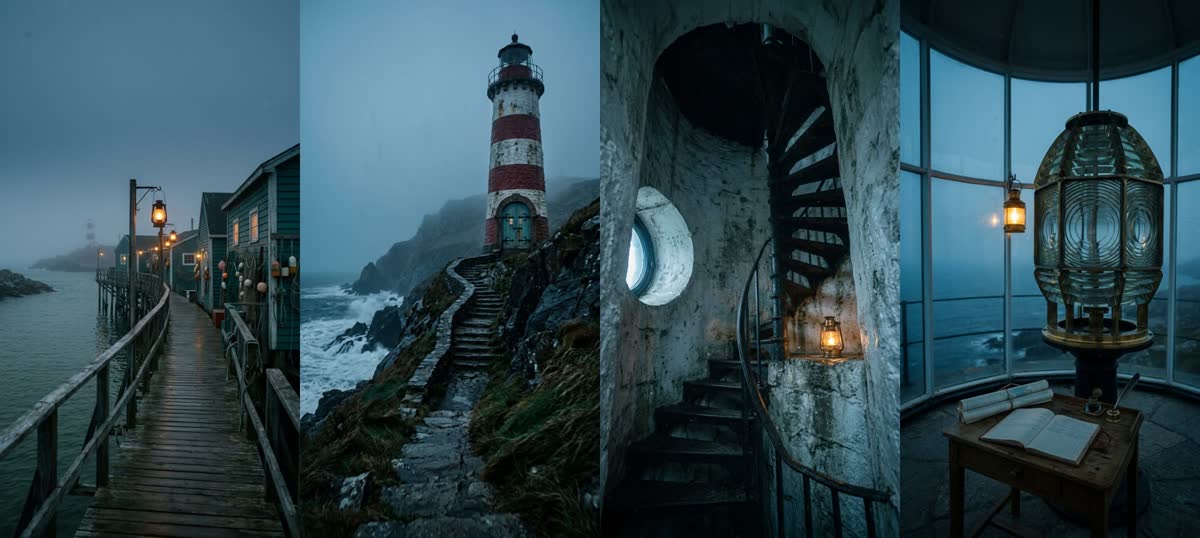
A hero portrait and a turnaround sheet of Nora (front, three-quarter, profile, back and face close-ups), a prop sheet for Pip, and four location plates: the boardwalk, the lighthouse path, the stairwell and the lamp room. All of them were generated with Gemini 3.1 Flash Image from the written bible.
How was each shot made?
- A first frame was composed from the character sheet, the location plate and the shot description.
- Series Lock ran a face identity check on the frame against Nora's anchor and redraws a frame that fails. For this case study we also measured every frame with ArcFace (w600k_r50).
- Google Veo 3.1 Lite animated the frame for 6 seconds at 720p, image to video, with ambient sound.
- Dialogue was voiced with Nora's fixed voice and captioned.
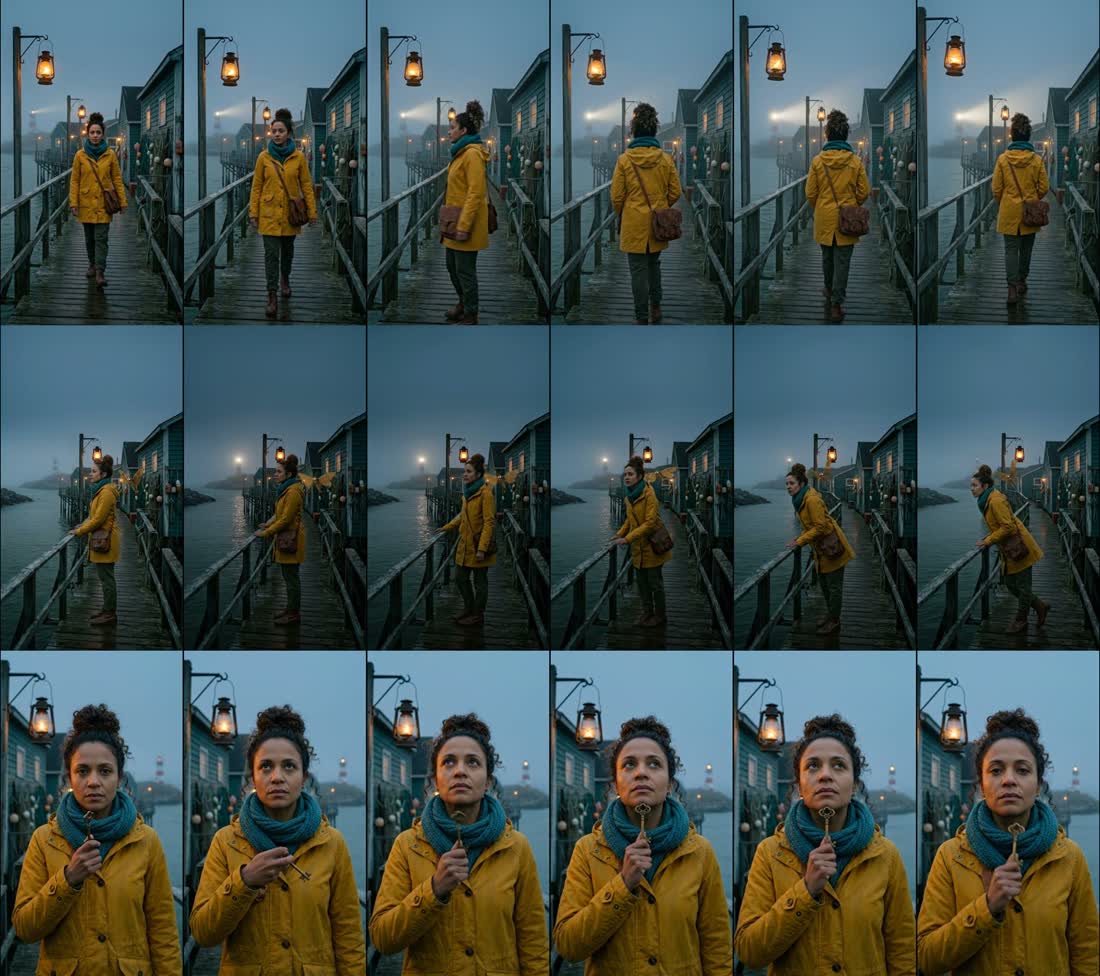
How consistent was the character?
For the measurement we used 0.58 as the same-person line. Front close-ups across all three episodes scored 0.64 to 0.74; a text-only lookalike with the same description, no bible and no references, scored 0.50 to 0.55.
First frame of each shot
| Shot | Similarity to anchor | Note |
|---|---|---|
| 1.1 | 0.656 | Face large enough to measure |
| 1.2 | 0.465 | Small face, too little detail to score reliably |
| 1.3 | 0.763 | Face large enough to measure |
| 2.1 | n/a | Wide shot from behind, no visible face |
| 2.2 | 0.490 | Small face, too little detail to score reliably |
| 2.3 | 0.696 | Face large enough to measure |
| 3.1 | 0.465 | Small face, too little detail to score reliably |
| 3.2 | 0.635 | Face large enough to measure |
| 3.3 | 0.680 | Face large enough to measure |
The three low scores are wide shots where the face is about 53 to 67 pixels tall. At that size the embedding has too little detail, so those frames hold identity through the coat, scarf, hair and silhouette. Every first frame with a face large enough to measure scored between 0.635 and 0.763.
Whole episodes
| Comparison | Identity score |
|---|---|
| Episode 1 vs anchor | 0.706 |
| Episode 2 vs anchor | 0.591 |
| Episode 3 vs anchor | 0.674 |
| Episode 1 vs episode 2 | 0.638 |
| Episode 1 vs episode 3 | 0.652 |
| Episode 2 vs episode 3 | 0.693 |
What still drifts during motion?
In episode 1, shot 3 (a close-up with faces around 205 pixels), 100% of the large faces across the 6 seconds of motion stayed above the same-person line, with an average of 0.703. Close-ups where the face turns or is lit from the side held less: 24% of large-face frames in episode 2, shot 3, 8% in episode 3, shot 2, and 6% in episode 3, shot 3.
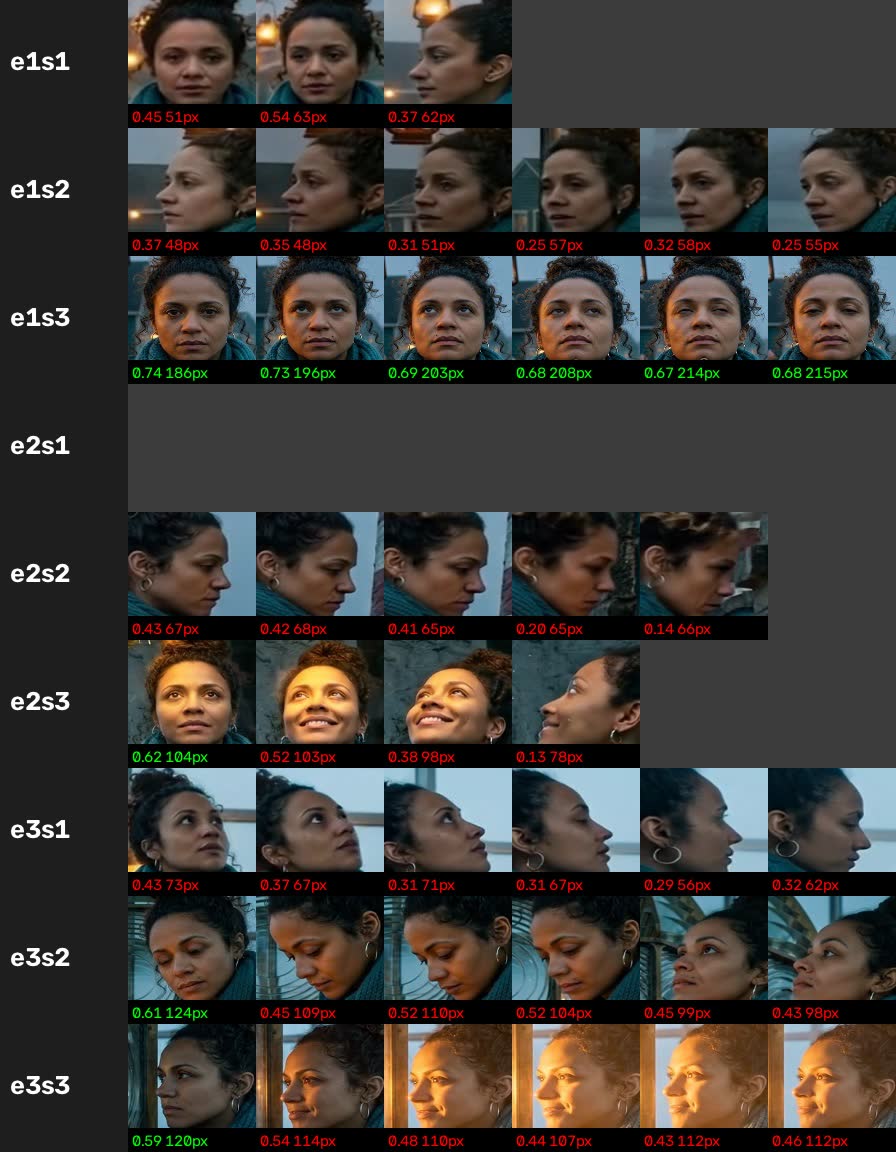
Motion models still redraw a face as it turns or as the light moves across it. That is why Series Lock checks the first frame before paying for motion, and why only a shot that drifts is redone, leaving the rest of the episode untouched. Faces under about 80 pixels cannot be measured either way.
What did it cost?
| Item | Cost |
|---|---|
| Whole demo, 3 episodes, tests included | US$6.41 |
| Production cost per final second | about US$0.08 |
| Veo 3.1 Lite motion, per second | US$0.05 |
The rest of the per-second cost is the reference frames and the checks. We also tried Veo 3.1 Fast with reference images: identity came out worse and it cost about twice as much, so Series Lock animates from the locked frame with Veo 3.1 Lite.
In Sentarys, the same series costs 6,000 credits for the bible and 14,400 credits per 18 s episode (800 credits per second, minimum 4,800 per shot). Pro is US$10 a month with 30,000 credits, and credits come back when the video model blocks or fails a shot.
What did we learn?
- References beat descriptions. The same written description without references landed below the same-person line.
- Write identity moments as close-ups facing the light. The front close-up in episode 1 held for all 6 seconds.
- Use wide shots for movement. Small faces carry identity through wardrobe and silhouette, and that worked on screen.
- Measure, then redo one shot. A shot-level redo keeps the good shots and the cost down.
The step-by-step guide explains the method for any tool, and the comparison covers other tools' consistency features. To make your own series, create an account.
FAQ
Which model animated Saltmere?
Google Veo 3.1 Lite, image to video from the locked first frame, at 720p with ambient sound. The reference images were made with Gemini 3.1 Flash Image.
How was face similarity measured?
With ArcFace (w600k_r50) embeddings and cosine similarity against Nora's anchor portrait, using 0.58 as the same-person line for the measurement.
How much did the demo cost?
US$6.41 for all three episodes including tests, about US$0.08 per final second.
Did the character stay identical in every frame?
No. Front close-ups held well; faces that turned or were lit from the side drifted during motion, and small faces could not be measured. The first-frame check and shot-level redo are how Series Lock handles that.
Can I make a series like this myself?
Yes. Series Lock is part of Sentarys Pro. A bible costs 6,000 credits and an 18 s episode 14,400 credits, out of 30,000 credits a month for US$10.
Ready to try Sentarys?
Paste a link or upload a video and get finished clips with captions. 6,000 free credits on signup, no credit card required.
Get Started FreeRelated Articles
How to Keep the Same Character Across an AI Video Series
A practical method for consistent AI characters: write a series bible, build a turnaround sheet, start every shot from a reference frame, measure the face, animate, and redo only the shot that drifts.
AI Video Tools for Consistent Characters in 2026: An Honest Comparison
Runway, Kling, LTX Studio, Higgsfield, OpenArt, Pika, Hedra, Google Flow and Sentarys Series Lock compared on how they keep a character the same across shots. Features checked on official pages on 2026-10-07.
How to Auto Clip Your Twitch Stream While You Are Still Live
Chat spikes, voice spikes and the story around them: how automatic Twitch clipping finds real moments, skips donation readings and hands you captioned vertical clips before the stream ends.